Have you ever stood on a beach in Dubai and wondered where all those forgotten plastic bags eventually end up? It is a sobering thought, but one that the United Arab Emirates has decided to tackle head-on. As we hurtle toward 2026, the landscape of retail and packaging in the Middle East is shifting more rapidly than the dunes of the Empty Quarter. The tide of single-use plastic is going out, and in its place, a new wave of sustainable innovation is rising. For businesses across the seven emirates, the search for the Top Non-Woven Bag Manufacturers in the UAE is no longer a “nice-to-have” sustainability project; it is a mission-critical survival strategy.
I noticed that many procurement managers feel overwhelmed by the impending January 1, 2026, deadline. They ask: Is non-woven truly the best alternative? Who can I trust with a 100,000-unit order? How do I ensure my brand doesn’t just “comply” but actually “stands out”? This report is designed to answer those questions with expert-level depth. We are going to dive deep into the technical specifications, the regulatory hurdles, and the brand leaders like Pangea that are defining the next decade of Middle Eastern commerce.
Why 2026 is the Hard Deadline Your Business Cannot Ignore
Think of the 2026 plastic ban like a structural renovation of a skyscraper. You cannot just swap out a few bricks; you have to rethink the entire foundation. The UAE Ministry of Climate Change and Environment (MOCCAE) has been very clear: Ministerial Decision No. 380 of 2022 is the law of the land. By the time we reach the start of 2026, the import, production, and trade of nearly all common single-use plastic items will be prohibited.
This is the final phase of a three-year plan. If you are still using plastic plates, cups, lids, or cutlery by 2026, you aren’t just hurting the planet—you are risking heavy fines and reputational damage that could sink your brand. The market for non-woven bags is exploding as a result. Globally, this market is projected to hit $4,725.45 million by 2026, growing at a CAGR of 7.5%. In the UAE, where we have some of the highest per capita plastic consumption in the world, the shift toward the Top Non-Woven Bag Manufacturers in the UAE is even more dramatic.
The Regulatory Breakdown for UAE Businesses
| Phase | Effective Date | Items Banned |
|---|---|---|
| Phase 1 | Jan 1, 2024 | All single-use plastic shopping bags |
| Phase 2 | Jan 1, 2025 | Styrofoam containers, plastic straws, and stirrers |
| Final Phase | Jan 1, 2026 | Beverage cups, lids, cutlery, plates, and food boxes |
One specific detail that often catches retailers off guard is the 50-micron rule. Even paper bags are banned if they are thinner than 50 microns. This creates a massive opportunity for non-woven polypropylene (PP) bags, which naturally exceed this thickness while remaining lightweight and incredibly durable.
The Problem with Single-Use: Beyond the Environmental Surface
Why is the government being so aggressive? Is it just about the turtles? While marine life protection is a huge part of it, the problem is much deeper. Every year, millions of tonnes of plastic waste are generated, and about 50% of it is tossed after just one use. These plastics do not disappear; they break down into microplastics that infiltrate our water, our food, and even our bodies.
For a business, the “problem” is also a financial one. Using outdated plastic packaging in 2026 is like trying to sell leaded gasoline in 2024. Consumers in Dubai and Abu Dhabi are increasingly eco-conscious. They evaluate brands through the lens of ethics and social alignment. If your premium product arrives in a flimsy, banned plastic bag, you have created a “friction point” that erodes customer trust. By partnering with Top Non-Woven Bag Manufacturers in the UAE, you aren’t just following the law; you are investing in a “mobile billboard” that signals your brand’s modern values.
The Non-Woven Solution: Why It Is the Reusable King
So, what exactly is a non-woven bag? Have you ever felt a material that feels like cloth but has the resilience of plastic? That is likely non-woven polypropylene. Unlike traditional fabrics that are woven or knitted, non-woven materials are created by bonding fibers together using heat, chemicals, or mechanical pressure.
The Material Science of Success
The magic of non-woven fabric lies in its versatility. Most of these bags are made from Polypropylene (PP) or Polyethylene Terephthalate (PET).
- Polypropylene (PP): Accounts for 73% of the global market. It is economical, water-resistant, and available in various weights.
- PET: Often made from recycled water bottles, PET non-woven bags are the premium, eco-conscious choice for luxury brands.
What makes them the hero of 2026? It is the balance. They are 100% recyclable, incredibly lightweight for shipping, and strong enough to be used hundreds of times. When you search for Top Non-Woven Bag Manufacturers in the UAE, you are looking for partners who understand this chemistry.

Top Non-Woven Bag Manufacturers in the UAE: 2026 Industry Rankings
Navigating the supplier landscape in the Middle East can feel like a maze. To help you find the right fit, I have analyzed the top players based on capacity, customization, and sustainability credentials.
1. Pangea International: The Gold Standard for Global Export
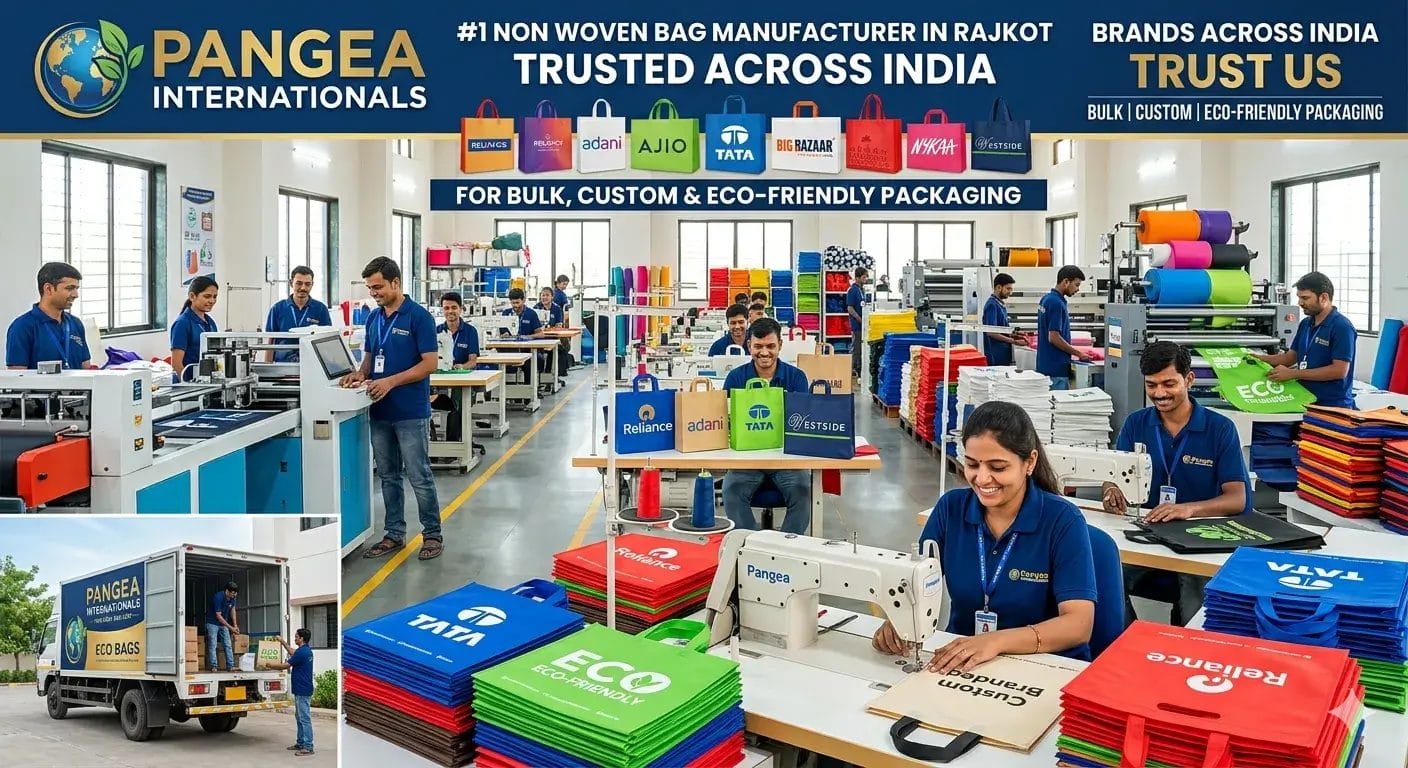
When it comes to the Top Non-Woven Bag Manufacturers in the UAE, Pangea International (https://www.pangeainternationals.com/) stands out as a titan of the industry. Although their primary manufacturing hub is in Rajkot, India, they have become the go-to partner for the largest hypermarkets and supermarkets in the UAE, Oman, and Saudi Arabia.
Why Pangea Dominates the 2026 Market:
- The “Micro-Buyer” Strategy: They noticed that many small businesses need high quality but low minimum order quantities (MOQs). Pangea caters to these “micro-buyers” with the same precision they offer to global giants.
- Advanced Customization: From U-Cut bags to luxury laminated box bags, they offer branding options that make your bag look like a high-end fashion accessory rather than a grocery carrier.
- Logistics Mastery: Shipping from Rajkot to the UAE is handled seamlessly with both FOB and CIF rates, supported by a professional logistics team that ensures your inventory arrives on time, every time.
Pangea’s commitment to a circular economy is not just marketing speak. Their motive since 2019 has been to develop the perfect replacements for single-use plastic. If you are looking for a manufacturer that balances cost-effectiveness with world-class durability, Pangea is the definitive starting point.
2. Zubairi Packaging: The Ajman Industrial Powerhouse
If you are looking for localized production within the emirates, Zubairi Packaging is a household name. Based in Ajman, they have over 17 years of experience and a massive annual capacity of 18,000 metric tons. They are pioneers in the UAE extrusion domain, taking complete ownership of the process from raw granules to finished bags. Their focus on sustainable energy sources by 2030 makes them a future-proof partner for the 2026 mandate.
3. Hotpack Global: The Diversified Leader
Hotpack is a giant in the global packaging scene, operating in over 100 countries. While they produce everything from paper cups to wooden cutlery, their non-woven division is a key player among the Top Non-Woven Bag Manufacturers in the UAE. They are particularly strong in providing integrated solutions for the HORECA (Hotel, Restaurant, and Cafe) sector, ensuring that every piece of packaging is compliant with the 2026 ban.
4. Adams Carry Bags: The Branding Experts
Based in Dubai, Adams Carry Bags specializes in spun-bond polypropylene. They have built their reputation on helping organizations make “unique impressions.” They treat every bag as a platform for customer engagement, offering high levels of tailoring in color, size, and style.
Comparison of Top Manufacturers in the UAE
| Manufacturer | Location | Key USP | Best For |
|---|---|---|---|
| Pangea International | Rajkot (Export to UAE) | Global scale, micro-MOQs, luxury lamination | Supermarkets, Boutique Brands, Events |
| Zubairi Packaging | Ajman, UAE | 18,000 MT capacity, local extrusion | High-volume industrial & retail |
| Hotpack Global | Dubai/Global | Diversified product range, massive global reach | Hospitals, Hotels, Large Chains |
| Adams Carry Bags | Dubai, UAE | Intense focus on branding & consumer appeal | Promotional campaigns, Corporate gifting |
The Technical Blueprint: What Every Procurement Manager Must Know
Choosing a manufacturer is step one. Step two is understanding the “engine” of the bag. If you don’t know your GSM from your ultrasonic welding, you might end up with a shipment of bags that fail the first time a customer loads them with a few heavy cans of chickpeas.
Understanding GSM: The “Weight” of Your Reputation
GSM stands for grams per square meter. In the world of the Top Non-Woven Bag Manufacturers in the UAE, GSM is the most direct indicator of fabric strength.
- 40–60 GSM: The “Lightweights.” Think of these as the flyers of the bag world. They are great for one-time giveaways or carrying lightweight items like bread or cosmetics.
- 70–90 GSM: The “Workhorses.” This is the sweet spot for reusable shopping bags. An 80 GSM stitched bag strikes the best balance between cost and durability for most supermarkets.
- 100–120 GSM: The “Premium” Tier. These have a textile-like feel. They feel sturdy and expensive. Brands looking to communicate luxury often opt for 100 GSM or higher.
- 140+ GSM: The “Industrial” Grade. Usually double-laminated, these bags can carry 15–25 kg without breaking a sweat.
Sealing the Deal: Ultrasonic vs. Heat Sealing
How the bag is put together is just as important as the material.
- Ultrasonic Sealing: This is the modern standard used by Top Non-Woven Bag Manufacturers in the UAE. It uses high-frequency vibrations to melt the fibers together in milliseconds. It is 25% more energy-efficient and allows for much higher precision in design.
- Heat Sealing: Uses heated bars to press the edges. While it can produce a wider, more robust seal, it is slower and consumes significantly more energy.
- Stitching: The old-school way. Hand-stitched or machine-stitched bags are incredibly rugged but come with a higher labor cost.
Logistics and Procurement: The Path from Rajkot to Your Warehouse
Buying in bulk can be a logistical headache. Have you considered the Total Landed Cost (TLC)? When you work with a company like Pangea, you need to account for more than just the unit price.
Calculating the Total Landed Cost (TLC)
To truly understand your investment, use this formula:
TLC=(P×Q)+F+D+I+W
- P: Unit Price from the supplier.
- Q: Total Quantity.
- F: Freight cost (Sea transport is most common for non-woven bags from India to the UAE).
- D: Customs Duties and Taxes. (Standard VAT in the UAE is 5%).
- I: Insurance costs.
- W: Domestic warehousing and handling.
Mastering the HS Code Maze
A common mistake procurement managers make is using the wrong HS (Harmonized System) code. If you get this wrong, Dubai Customs might delay your shipment or slap you with extra fees.
- HS Code 4202: This is the “safe bet” for most non-woven shopping and promotional bags.
- HS Code 6305: Often used for sacks and bags intended for packing industrial goods.
- HS Code 5603: Refers primarily to the non-woven fabric itself rather than the finished bag.
Case Study: The “Micro-Buyer” Success Story with Pangea
Let’s look at a real-world example. A boutique skincare brand in Dubai needed 500 high-quality, branded bags for a launch event. Traditional Top Non-Woven Bag Manufacturers in the UAE quoted them MOQs of 5,000 units—far beyond their budget and storage capacity.
By partnering with Pangea, they were able to secure a “micro-order” of 500 units. Pangea used 100 GSM non-woven fabric with a matte lamination and gold metallic ink. The result? The bags were so beautiful that attendees kept them for months, using them as beach totes and gym bags. This “secondary use” provided the brand with thousands of additional impressions long after the event ended.
Environmental Impact: The Truth About Reusability
Is non-woven actually better than paper or plastic? It depends on you—the consumer.
- Plastic Bags: Are “light” on production energy but a disaster as litter.
- Paper Bags: Require massive amounts of water and chemicals to produce. You have to use a paper bag at least 3-4 times to equal the carbon footprint of one plastic bag.
- Non-Woven PP: These require more energy to make than a thin plastic bag. To be truly “green,” you need to use your non-woven bag 10 to 20 times.
- Cotton Bags: The biggest surprise—you need to use a cotton bag 50 to 150 times to offset its high production impact.
The key takeaway? Non-woven is the pragmatic middle ground. It is durable enough to last for 50+ uses but lightweight enough to keep shipping emissions low.
Conclusion: Are You Ready for January 1st, 2026?
The countdown is on. As the UAE moves toward its Net Zero 2050 goals, the transition to sustainable packaging is a train that is not stopping. By choosing the right partners among the Top Non-Woven Bag Manufacturers in the UAE, you aren’t just complying with the law—you are positioning your brand as a leader in the green revolution.
Whether you are a local cafeteria or a global retail chain, the time to audit your supply chain is now. Don’t wait for the 2025 holiday rush when lead times will skyrocket and inventory will vanish. Reach out to an expert like Pangea International today. Secure your samples, verify your GSM, and let your packaging speak volumes about your commitment to a cleaner, greener UAE.
Ready to lead the change? Contact Pangea today at +91-99098-55905 or visit their website to start your transition to world-class non-woven solutions.
5 Original FAQs for UAE Business Owners
1. Is the 2026 ban applicable to all types of plastic bags? Yes, the January 1, 2026 mandate is a comprehensive federal ban on all single-use bags regardless of the material. A critical part of this is the “50-micron rule”—if a bag is thinner than 50 microns, it is prohibited, even if it is made of paper.
2. Why should I choose Pangea over a local UAE manufacturer? While the UAE has excellent local manufacturers, Pangea International offers a unique “micro-buyer” model, allowing smaller businesses to access premium, luxury-grade customization (like photo-quality lamination and metallic inks) that is often only available to high-volume buyers in the local market.
3. What is the most durable non-woven bag style for grocery shopping? For heavy groceries, the “Loop Handle Box Bag” or a “Stitched Non-Woven Bag” with a GSM of 90–120 is ideal. These styles can handle up to 15-20 kg and maintain their shape, making them a favorite for supermarket customers.
4. How does Pangea ensure their bags are actually 100% recyclable? Pangea uses pure polypropylene (PP) fibers. Unlike “blended” fabrics that mix plastic with cotton or paper (which are almost impossible to recycle), pure PP non-woven can be melted down and repurposed into new products, supporting a true circular economy.
5. What happens if my business does not switch by the 2026 deadline? The Ministry of Climate Change and Environment has specified that by mid-2026, inspections will become strict. Non-compliant businesses face heavy fines, the potential pulling of their products from retail shelves, and significant reputational damage in a market that is increasingly prioritizing environmental awareness.